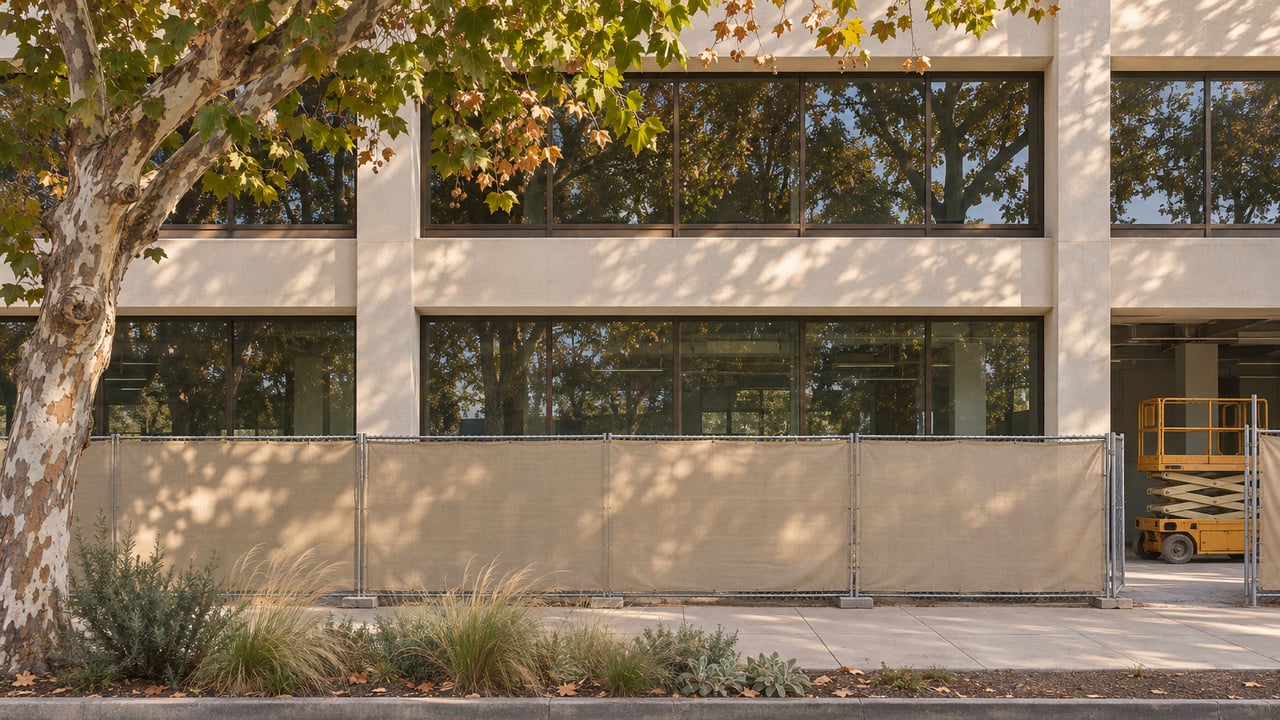
The first new workers at Pico and Westwood are contractors. UCLA's construction page for the former Westside Pavilion gave Monday, October 26, as the proposed start date. The first job on the list is a sound wall along the south edge of the site, facing Ayres Avenue. After that, crews move into the buildings for interior and roof demolition. They will cut new floor openings for utility shafts and stairs, reroute utilities, put up scaffolding, and remove trees and paving.
This is the start of UCLA Research Park, and it has been announced with big numbers. Much of the coverage leads with jobs, billions in research money and a lab campus next to the Expo Line. For anyone living on the blocks south of Pico, the dates matter more. The construction schedule runs from this fall through the end of 2027. The full workforce of thousands is years away and depends on hiring and on money that is still being decided.
What is scheduled on the Ayres Avenue side
UCLA posts an impact schedule for Research Park East, the former main mall building at 10800 W. Pico Blvd., and says it will update the page monthly. The first activities run as follows:
| Activity | Location | Anticipated window | UCLA's noise rating |
|---|---|---|---|
| Sound wall installation | South lot, facing Ayres | Oct. 26 to Nov. 20, 2026 | Medium |
| Sound blanket installation | South lot | Oct. 26 to Nov. 20, 2026 | Medium |
| Saw-cutting the concrete roof deck | Roof of Research Park East | Nov. 2, 2026 to Feb. 2, 2027 | Medium |
| Site demolition: landscaping, hardscape, grading | South lot | Nov. 2, 2026 to Dec. 30, 2027 | Low, with medium dust |
Site mobilization at both buildings has no end date on the schedule. UCLA rates its traffic impact as moderate, and the schedule has contractors parking in Research Park West, the former Westside Two building across Westwood Boulevard. Work hours are Monday through Friday, 7 a.m. to 5 p.m. Construction concerns go to [email protected].
The schedule is set for weekdays, and the longest item runs through the end of 2027. The roof saw-cutting goes through the holidays and into February. Grading and hardscape removal on the south lot, the part of the site closest to Ayres, is scheduled to last more than a year.
The trees will change too. UCLA's May 20 community presentation said any protected sycamores and oaks removed from the site will be replaced at a ratio of at least two to one. It also noted that most of those trees were planted recently, by Google. The same presentation said most of the work will happen inside the existing buildings. It calls for no mass grading, a maximum excavation depth of 10 feet in new construction areas, and new terraces and landscaping.
How a mall that Google never used ended up with UCLA
The site has been mostly empty for a long time. Hudson Pacific Properties and Macerich announced on Jan. 3, 2024, that they had sold the former Westside Pavilion to UCLA for $700 million. The deal covered One Westside and Westside Two, about 687,000 square feet. The Los Angeles Business Journal reported that Google had signed a 14-year lease running through 2036 and never moved in. The Business Journal reported that the lease ended when UCLA's purchase closed. UCLA's announcement of the purchase said Google helped make the acquisition possible.
UCLA's September 2026 environmental findings describe the finished project. The 9.3-acre site would have more than 800,000 gross square feet of scientific space and about 29,000 square feet of open space. It would keep about 1,100 parking spaces on site, and the existing enclosed bridge over Westwood Boulevard would still connect the two buildings. The plan includes wet and dry labs, offices, instructional and meeting space, and food service.
The same document gives the timeline. Phased construction starts in 2026. The East building's core and shell and the first tenant buildouts are expected in late 2027, and full buildout is expected by 2035. The May community slides give a range of 2026 to 2036. Either way, Rancho Park has about ten years of work ahead at this corner.
Who is meant to move in
UCLA has named three initial tenants for Research Park East:
- The California Institute for Immunology and Immunotherapy, or CIII, which says it is leasing 235,000 square feet of research space on the site.
- The UCLA Quantum Innovation Hub, which UCLA Magazine said would probably move in late 2027 with 40,000 square feet of initial labs. It named HRL Laboratories as an early collaborator and Boeing as a potential partner.
- The David Geffen School of Medicine.
UCLA's September material for the Regents said any further buildout of the East and West buildings depends on finding more tenants and securing more funding.
Why the buildings will fill gradually
CIII is planned as the largest employer on the site. In February 2025 the Los Angeles Business Journal reported that the institute expected about 5,000 employees at full buildout, including about 500 bioscience researchers.
The institute is at an early stage. CalMatters reported in October that CIII had three employees as of September. They were a chief operating officer, a general counsel and a scientific advisor, and a search for a director was underway. UCLA Health CEO John Mazziotta, who also sits on the institute's board, gave those numbers at the Sept. 16 Regents meeting. Under its 2024 affiliation agreement with UCLA, the institute had planned to hire about 51 people by summer 2025.
The agreement anticipated a wait for the building. It lets the institute use UCLA health research space elsewhere in the meantime, and Mazziotta told the Regents that research is already underway there. CalMatters, citing the September Regents agenda, put full completion of the institute's facility at late 2028 at the earliest. Mazziotta also said the institute's construction costs still need about $100 million, and that UCLA was in serious talks with a donor for about $50 million of that.
So the corner will see scaffolding and saw-cutting first. The first labs are targeted for late 2027, and the large workforce in the forecasts will build up after that as hiring and funding allow.
Two November decisions that set the pace
Money for the site comes from several sources at once. When UCLA announced the purchase in January 2024, it said California had allocated $200 million toward the immunology institute and planned a total state investment of $500 million. Two decisions this month could shape how fast the work moves.
The Regents' capital vote. In September, the UC Regents approved the scope and design of the Research Park East core and shell, along with $34.4 million for an early phase covering demolition and site and utility prep, as Urbanize LA reported. That early phase covers the work now scheduled near Ayres. UCLA's project page puts the total estimated cost at $54 million. The full core-and-shell request was listed as item F6 on the Finance and Capital Strategies Committee agenda for November 18, during the Regents' November 17 and 18 meeting at UCSF.
Proposition 38. This statewide bond would authorize up to $8.4 billion for research on immune-system diseases. Half would go to a single research institute that meets very specific criteria. CalMatters reported that CIII is the only institute in California that currently meets them. In the CalMatters results updated early on Nov. 9, Yes led 54.3% to 45.7% with 77% of ballots counted. The California Secretary of State labels its returns unofficial while mail, provisional and other ballots are still being counted. If the measure passes, CalMatters reports, the money would be released in installments as the institute requests it and senior state officials approve each request.
Neither decision changes what happens on the south lot next week. The sound wall, the roof saw-cutting and the grading are already funded under the September approval. These two decisions mostly affect the later years: how soon the buildings have tenants and how many people work there.
What to watch on the street through 2027
For a household a few blocks from Pico and Westwood, the near-term effects come from UCLA's own documents. Workday construction runs from 7 a.m. to 5 p.m., Monday through Friday. Contractors park in Research Park West. The south lot along Ayres is scheduled for demolition and grading until the end of 2027. UCLA says it will update the construction page monthly, so new work will be posted there before it starts.
The largest effects come later. Late 2027 is the target for the East building's shell, the first tenant spaces and the Quantum Innovation Hub's move. That is when weekday foot traffic between the Expo station and the old mall should start to pick up. Until then, the project's presence in the neighborhood is a construction site with a sound wall facing Ayres Avenue.
If you own near Pico and Westwood and want to know how a ten-year campus build next door affects your home's value, Zack Grakal and the BGG team can go through it with you street by street. Get Your Instant Home Valuation to start with a clear number.